 ScribeShot
How to use active recall with your notes
Active recall changes the role of notes. Instead of being material you repeatedly read, the notes become an answer key you consult after trying to produce the idea yourself.
Turn each important note into a cue
A cue should make you produce something. Convert descriptive headings into questions:
- “Database indexes” → “Why can an index speed reads but slow writes?”
- “Gradient descent” → “What does the learning rate control, and what happens when it is too large?”
- “OAuth flow” → “Can I redraw the authorization-code flow from memory?”
Use blank-page retrieval for connected ideas
For a whole topic, start with a blank page and write everything you can reconstruct: concepts, relationships, examples, diagrams, and uncertainties. Then compare with the source notes. This works well when the knowledge is connected and would be awkward to split into dozens of tiny flashcards.
Redraw visual material
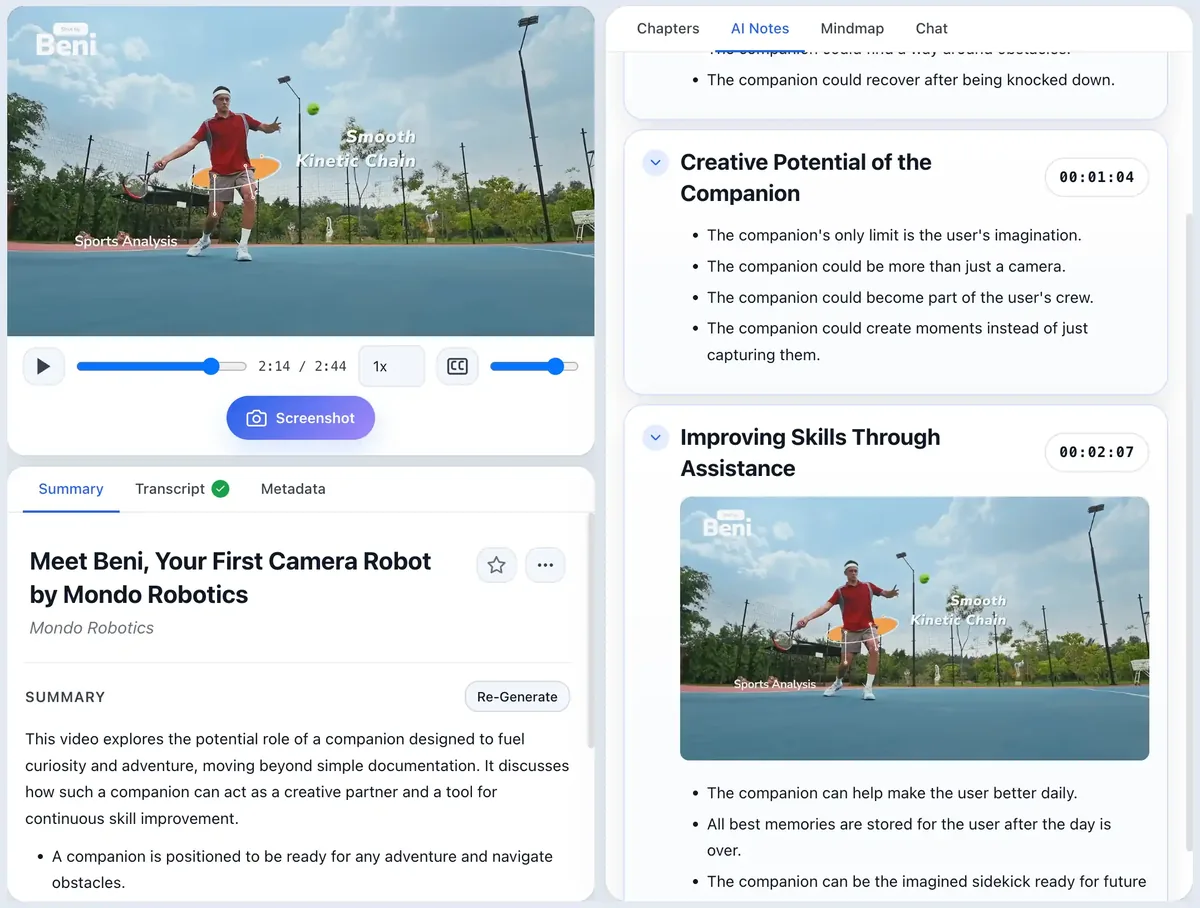
If you kept an architecture diagram or process screenshot, hide it and redraw the important structure. Then reveal the screenshot and mark what you missed. The visual becomes feedback instead of something you merely recognize.
Use practice before explanation for technical skills
For programming, mathematics, design tools, or operational workflows, retrieval should often be an action: write the function, solve the problem, configure the setting, explain the failure mode, or reproduce the sequence without the tutorial open.
Check the answer only after an attempt
The attempt is the important part. If you reveal the note too quickly, you replace retrieval with recognition. Give yourself enough time to struggle productively, then check the note, screenshot, or source timestamp and correct the gap.
Cue → attempt → reveal → correct → use → revisit later.
Do not make every detail a recall target
Active recall has a cost. Use it for concepts and skills where retrieval matters. Keep low-value details as searchable reference material. The goal is not to memorize your entire knowledge base.
Evidence and further reading
Cornell's Learning Strategies Center recommends retrieval practice and explains a “blank page” form of recall. The Learning Scientists also identify retrieval practice and spaced practice among the most strongly supported learning strategies. Read Cornell's guide and The Learning Scientists FAQ.
If your notes come from videos, pair this with timestamped notes so checking the original explanation takes seconds rather than a full rewatch.
Common questions
What is active recall?
Active recall, often called retrieval practice, means trying to bring information to mind without looking at the answer first.
Can I use active recall without flashcards?
Yes. Use blank-page recall, explain a concept aloud, answer your own questions, solve practice problems, redraw a diagram, or implement something from memory.
How do screenshots work with active recall?
Hide the screenshot and try to redraw or explain it first. Then reveal the original and compare structure, labels, states, or relationships you missed.
Turn saved video context into better review material
ScribeShot keeps the explanation, screenshot and timestamp available after you attempt retrieval, so checking an answer does not require scrubbing through the whole video.
Try 3 videos free • 3 screenshots per video • No credit card • Local AI option