 ScribeShot
How to review notes effectively
A review should answer a question: Can I retrieve and use this without looking? If the review only makes the page feel familiar, it can hide what you do not actually know.
Separate reference notes from learning notes
Not everything needs memorization. A command you can search in five seconds may only need a reliable reference. A concept you must explain in an interview, exam, design review, or production incident deserves retrieval practice.
Mark the small subset that is worth learning. This prevents an impossible review backlog.
Review with the notes closed first
- Look only at the topic or question.
- Explain the answer aloud, on paper, or in a blank document.
- Open the note and compare.
- Correct only what was missing or wrong.
- Return to the source when the note itself is insufficient.
This is a retrieval-first review. Cornell's Learning Strategies Center describes retrieval practice as bringing information to mind and using the result to identify what still needs work.
Convert headings into questions
A heading such as “CAP theorem” invites recognition. A question such as “What trade-off does CAP describe, and what does partition tolerance change?” requires production. Whenever a note matters enough to review, give yourself something concrete to answer.
Review weak material more often, strong material less often
Spacing is not about obeying a magical schedule. It is about allowing some forgetting and then successfully retrieving again. When an answer is effortless across several reviews, increase the interval. When you cannot reconstruct it, shorten the interval and improve the cue or explanation.
For video notes, use timestamps as evidence
When your answer is incomplete, click the timestamp and watch only the relevant explanation. If a diagram or code example carries the missing context, keep that visual beside the note. This is much more targeted than starting the video again from the beginning.
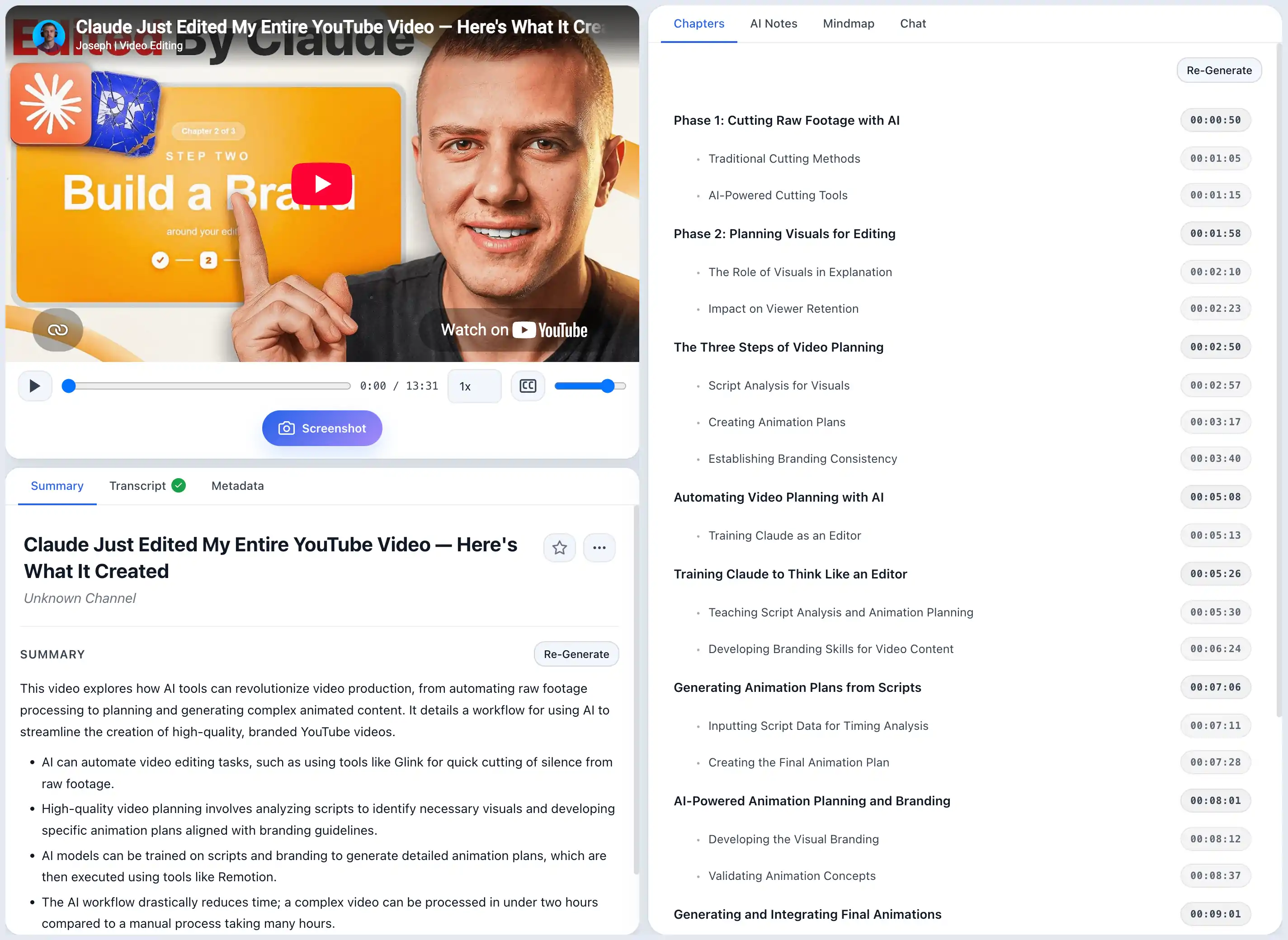
A 10-minute review routine
- 2 minutes: scan titles and choose the five ideas that matter today.
- 5 minutes: answer questions with notes closed.
- 2 minutes: check missed details and source timestamps.
- 1 minute: choose the next action or future review.
For the underlying learning method, see active recall with notes. For evidence-informed study guidance, see Cornell's effective study strategies.
Common questions
Is rereading notes useless?
No. Rereading can refresh context, but it is a weak test of whether you can retrieve the information independently. Pair it with recall, questions, practice, or application.
How often should I review notes?
There is no universal interval that fits every topic. Review important material after some delay, then increase the gap when retrieval is easy and shorten it when you repeatedly miss the idea.
Should I review every note I take?
No. Review notes tied to an ongoing project, exam, skill, decision, or long-term knowledge goal. Many notes are reference material rather than memorization material.
Make your video notes easy to revisit
Timestamped Markdown notes let you review the idea first and jump back to the exact video moment only when you need the original explanation.
Try 3 videos free • 3 screenshots per video • No credit card • Local AI option